
Indeed, India finds itself on the verge of experiencing one of the biggest technological revolutions in its recent history. With a population of more than 1.4 billion individuals, fast urbanization rates, increased connectivity, and a huge young generation, India now experiences unprecedented opportunities coupled with various challenges.
But how can quality education be brought to everyone? What should be done to provide health care to rural locations? How do businesses achieve scale in such a competitive environment? And what can be done about government services for tens of millions of people?
Artificial intelligence is the solution.
Modern AI is not something confined to labs or used by big corporations only. Instead, it is a technology that makes our learning, working, shopping, traveling, communication, and decision-making processes easier. Whether it is intelligent farming in villages or modern digital technologies used in urban areas, smart technologies help to solve many existing issues like never before.
If you are concerned about the AI Future in India, then the next decade is sure to become known as the era when technology was integrated in every aspect of life. The insights provided by AIPost prove that artificial intelligence is not just another innovation but rather a fundamental force that helps in shaping the future of India.
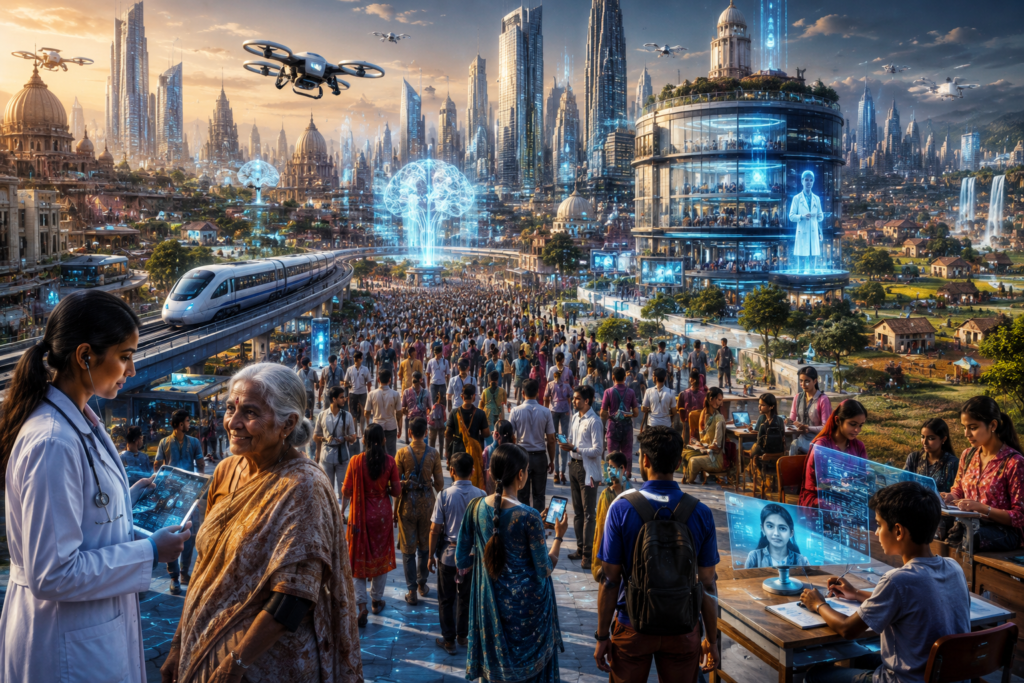
India’s Population Boom and the Need for Scalable Solutions
India’s population represents both a tremendous advantage and a significant challenge.
A growing population means:
- More consumers
- More workers
- More entrepreneurs
- More innovation
- Larger markets
However, it also creates pressure on:
- Education systems
- Healthcare infrastructure
- Transportation networks
- Employment opportunities
- Public administration
Traditional methods alone cannot efficiently manage such large-scale demands. This is where AI-powered systems become essential.
Unlike conventional tools, intelligent systems can process enormous volumes of information in seconds, identify patterns, automate repetitive tasks, and support decision-making. This capability allows organizations and governments to serve millions of people more effectively.
As India’s population continues to expand, scalable technological solutions will become increasingly important.
Understanding Artificial Intelligence in the Indian Context
Artificial intelligence refers to technologies that enable computers to simulate aspects of human intelligence, including learning, reasoning, prediction, language understanding, and problem-solving.
- Machine learning
- Natural language processing
- Computer vision
- Predictive analytics
- Deep learning
- Generative AI
Modern AI includes:
In India, these technologies are being adapted to local needs such as multilingual communication, rural development, digital governance, healthcare accessibility, and educational inclusion.
Rather than replacing human capabilities, AI often enhances them by helping people work faster, make informed decisions, and solve complex challenges more efficiently.
Why AI Is Becoming a National Priority
Countries around the world are investing heavily in intelligent technologies because they understand that AI will shape future economic leadership.
India is uniquely positioned for this transformation due to several factors:
Massive Digital Adoption
India has witnessed extraordinary growth in internet usage, smartphone penetration, and digital payments.
Millions of people interact with digital platforms daily, creating valuable data that can support intelligent systems.
Young Workforce
India possesses one of the world’s youngest populations.
Young professionals are generally more adaptable to emerging technologies and can drive future innovation.
Thriving Startup Ecosystem
The country has become one of the world’s leading startup hubs, encouraging experimentation, innovation, and technological development.
Strong Technology Sector
India already serves as a global center for software development, IT services, and digital transformation.
These advantages create a strong foundation for long-term AI growth.
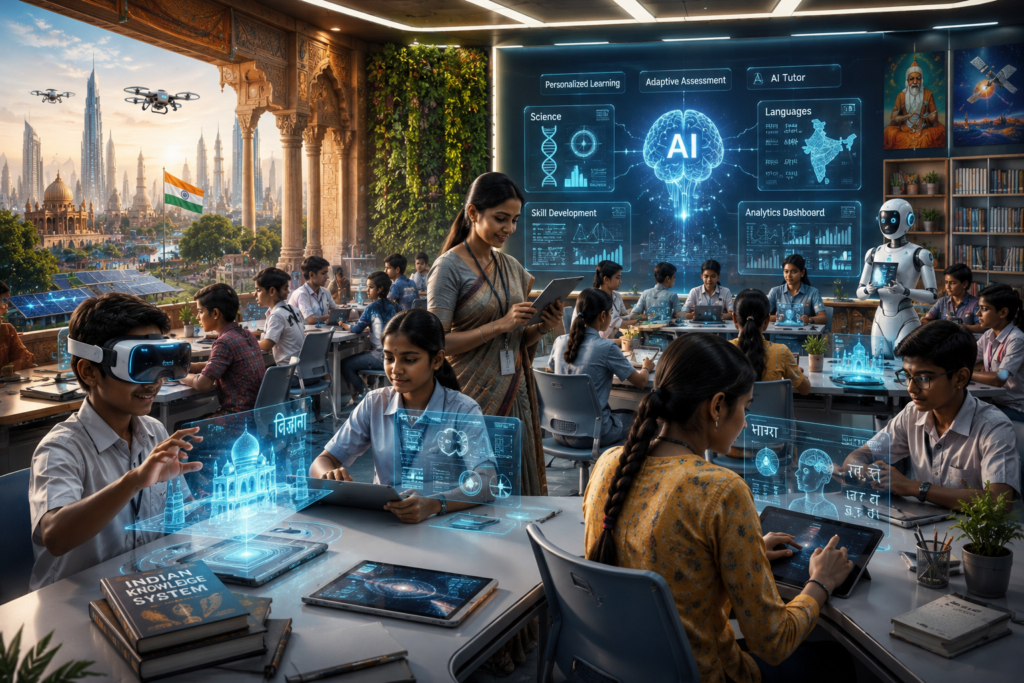
AI in Education: Building a Smarter Generation
Education remains one of the most important sectors for national development.
Personalized Learning Experiences
Traditional classrooms often struggle to address different learning speeds.
AI-driven educational platforms can:
- Analyze student performance
- Identify knowledge gaps
- Recommend customized learning paths
- Provide targeted practice materials
This creates a more personalized educational experience.
Intelligent Tutoring Systems
Virtual tutors can provide instant explanations and feedback, helping students learn independently.
Language Accessibility
India’s linguistic diversity presents unique educational challenges.
Advanced language technologies can translate educational content into multiple regional languages, increasing accessibility and inclusion.
Reducing Administrative Burden
Teachers spend significant time on grading and administrative tasks.
Automation allows educators to focus more on teaching and student development.
AI in Healthcare: Expanding Access and Saving Lives
Healthcare accessibility remains a major challenge in many regions.
Early Disease Detection
AI models can analyze:
- Medical images
- Diagnostic reports
- Health records
This supports earlier identification of diseases and improves treatment outcomes.
Telemedicine Expansion
Remote consultations are becoming increasingly common.
Patients in underserved areas can access healthcare expertise without traveling long distances.
Predictive Healthcare
Hospitals can use predictive models to forecast patient demand and optimize resource allocation.
Drug Discovery
Researchers are increasingly using intelligent systems to accelerate pharmaceutical development and medical research.
The long-term impact on public health could be transformative.
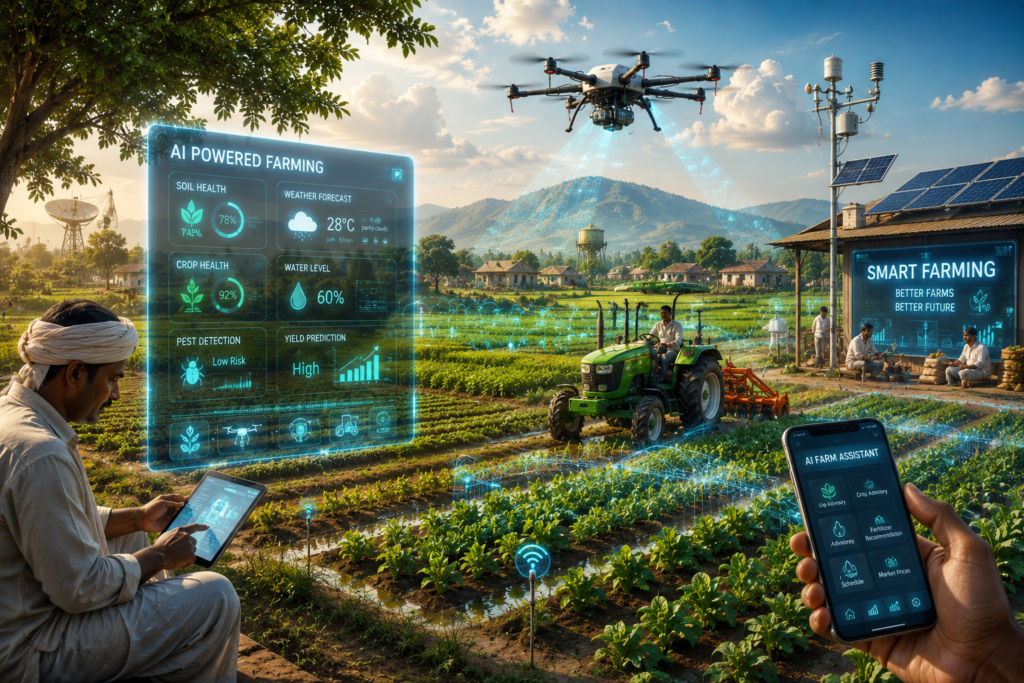
AI in Agriculture: Supporting Millions of Farmers
Agriculture supports millions of Indian families and contributes significantly to the economy.
Precision Farming
Farmers can use smart systems to monitor:
- Soil health
- Moisture levels
- Crop conditions
- Weather forecasts
This improves productivity while reducing waste.
Pest Detection
Computer vision technologies help identify crop diseases and pest infestations before they spread.
Yield Prediction
Predictive analytics assist farmers in planning production and managing risks.
Resource Optimization
Efficient use of water, fertilizers, and pesticides contributes to sustainability and profitability.
AI in Business and Entrepreneurship
Businesses across sectors are integrating intelligent automation into their operations.
Customer Service
AI-powered chatbots provide 24/7 support and improve customer satisfaction.
Marketing Intelligence
Companies can analyze customer behavior to deliver more relevant products and services.
Financial Forecasting
Advanced analytics support budgeting, investment planning, and risk assessment.
Startup Innovation
Entrepreneurs can leverage AI to develop scalable products with relatively low operational costs.
This creates opportunities for innovation across industries.
AI in Manufacturing and Industry 4.0
Manufacturing is undergoing a major transformation through automation and smart systems.
Benefits include:
- Predictive maintenance
- Quality control automation
- Supply chain optimization
- Reduced downtime
- Increased productivity
Factories are becoming more efficient, data-driven, and responsive to market demands.
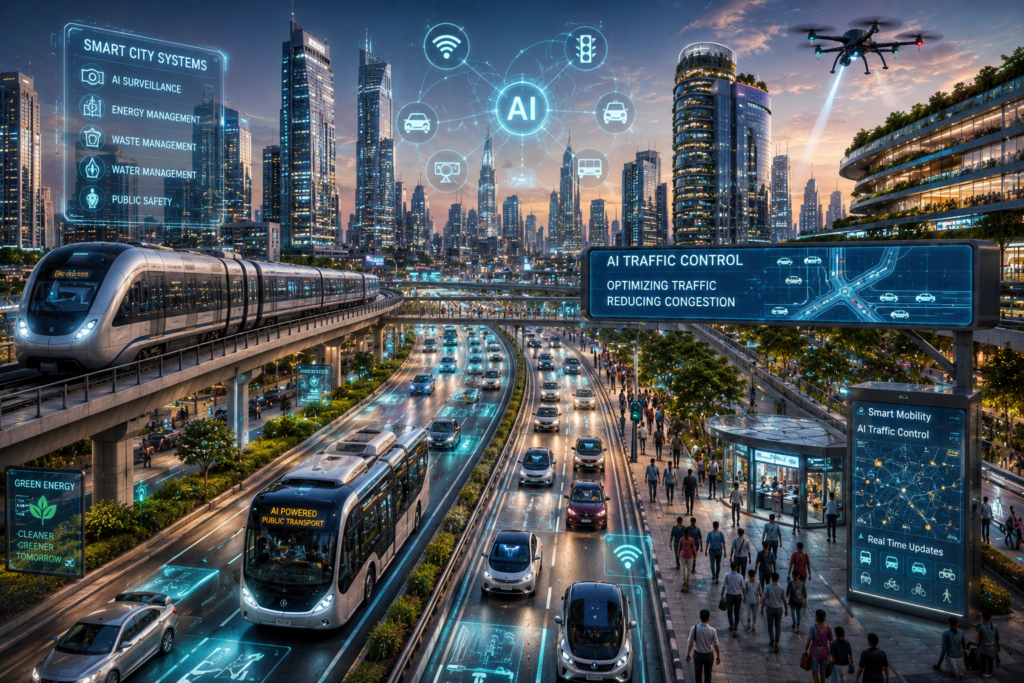
AI in Transportation and Smart Cities
Urban growth requires smarter infrastructure.
Traffic Management
Real-time analysis helps reduce congestion and improve road efficiency.
Public Transit Optimization
Data-driven systems improve scheduling and route planning.
Smart Infrastructure
Cities increasingly use sensors and analytics to manage energy, waste, water, and public safety.
The rise of Artificial Intelligence in Delhi demonstrates how advanced technologies can support smarter urban planning and improve quality of life.
AI in Government and Public Services
Governments are using technology to improve citizen services.
Faster Administrative Processes
Automation reduces delays and paperwork.
Fraud Detection
Intelligent systems help identify irregular activities in financial and administrative operations.
Better Policy Decisions
Data analysis enables evidence-based governance and resource allocation.
Citizen-Centric Services
Digital platforms simplify interactions between citizens and government institutions.
AI and India’s Cultural Evolution
Technology adoption does not require abandoning cultural values.
Instead, AI can strengthen and preserve cultural heritage.
Preserving Languages
India’s linguistic diversity can be documented and digitized through advanced language models.
Protecting Historical Knowledge
Archives, manuscripts, and cultural records can be digitally preserved.
Supporting Local Artisans
Small businesses and traditional craftspeople can access broader markets through digital platforms.
Enhancing Accessibility
Technology helps bridge social and geographic divides, promoting inclusion.
Employment, Skills, and the Workforce of Tomorrow
One of the most debated questions is whether AI will replace jobs.
The reality is more nuanced.
While some routine tasks may be automated, new opportunities are emerging.
Future demand is expected to grow for:
- Data scientists
- AI engineers
- Cybersecurity professionals
- Automation specialists
- Digital marketers
- Product managers
- Technology consultants
Success will increasingly depend on adaptability and continuous learning.
Challenges India Must Address
Despite its potential, AI adoption also presents challenges.
Data Privacy
Protecting personal information is essential.
Skill Gaps
Millions of workers will require upskilling and reskilling.
Ethical Concerns
AI systems must remain transparent, fair, and accountable.
Infrastructure Limitations
Rural areas still face connectivity and technological barriers.
Addressing these issues will be critical for sustainable growth.
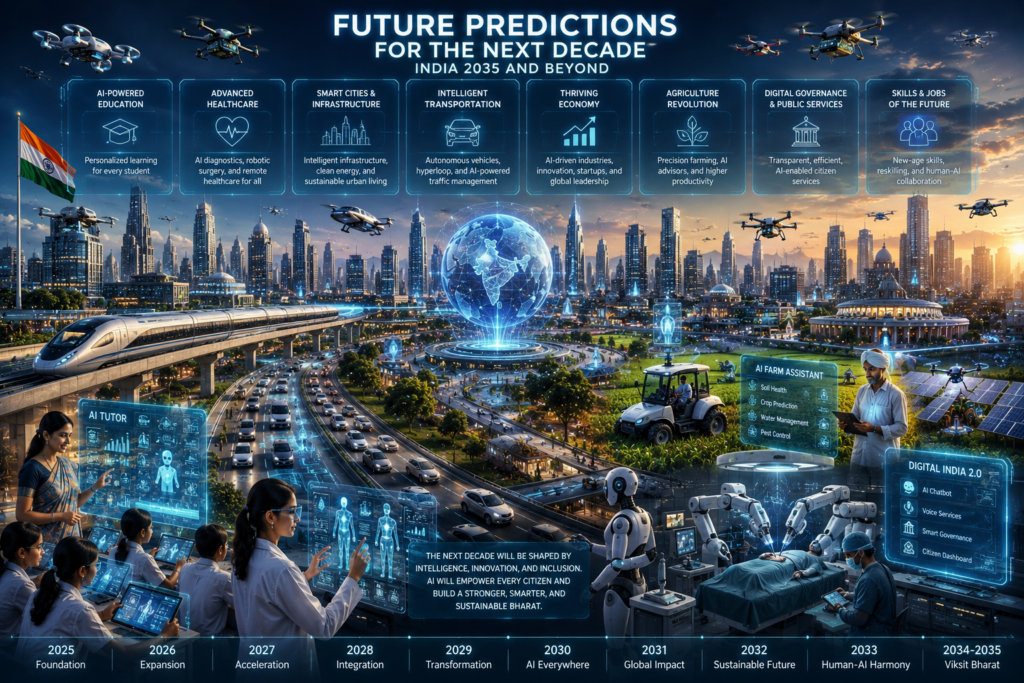
Future Predictions for the Next Decade
Over the next ten years, India may experience:
- AI-assisted classrooms becoming mainstream
- Personalized healthcare becoming widely accessible
- Fully digital government services
- Smarter transportation networks
- Significant growth in automation
- Increased productivity across industries
- Expansion of regional-language AI tools
- Greater global competitiveness in technology
India has the potential to become one of the world’s leading AI-powered economies.
Frequently Asked Questions
1. What is the future of AI in India?
The future appears highly promising as AI adoption expands across healthcare, education, agriculture, finance, manufacturing, and public services.
2. How will AI affect jobs in India?
AI will automate certain repetitive tasks while creating demand for new technology-focused roles and specialized skills.
3.Can AI help Indian businesses grow?
Yes. AI can improve efficiency, reduce costs, enhance customer experiences, and support better decision-making.